



Dr. Norman has written many scientific articles about parathyroid disease, and the proper way to treat it. He has also written or participated in the preparation of numerous articles in the lay-press (print and television) on hyperparathyroidism. One of his most famous articles was written to explain the 10 most important facts about parathyroid disease...and the myths that are laid to rest with these facts.
"The 10 Parathyroid Rules of Norman"
- There are no drugs that will make parathyroid disease better. None. [Read More]
- Nearly all parathyroid patients have symptoms; 95% know it--and feel bad. Most of the rest just don't know it until the disease is fixed. [Read More]
- Symptoms of parathyroid disease do NOT correlate with the level of calcium in the blood. Many patients with only slightly elevated calcium and parathyroid hormone will have BAD symptoms and develop lots of secondary health issues. [Read More]
- All patients with parathyroid disease have calcium levels and PTH levels that go up and down. Fluctuating levels of calcium are typical of parathyroid disease. [Read More]
- How high the calcium has become has nothing to do with the severity of hyperparathyroidism. It is the duration (in years) that the calcium is high that causes problems. [Read more]
- Taking Fosamax, Actonel, Boniva, or Reclast (etc) will NOT help bones that are being attacked by a bad parathyroid. These osteoporosis drugs have no place in the treatment of parathyroid disease. [Read More]
- Parathyroid disease is a lethal disease. But just like high cholesterol and high blood pressure, it takes 25 years before it starts killing. [Read More]
- There is only one treatment for parathyroid disease (hyperparathyroidism): Surgery to remove the parathyroid tumor (or tumors) [Read More]
- If your surgeon does not check all four glands, you have a 20% chance of not being completely cured and will need a second operation sometime in the future. [Read More]
- The success rate and complication rate for parathyroid surgery is VERY dependent upon the surgeon's experience. [Read More]
Explanations and Details Regarding the "10 Parathyroid Rules of Norman"
1. There are no drugs that will make parathyroid disease better. None.
Parathyroid disease is caused by a parathyroid tumor that makes too much parathyroid hormone. There is no way to take a drug to dissolve the tumor. Fosamax (and other osteoporosis drugs such as Actenol, Boniva, Evista, etc) will NOT counteract the effects of the hormone. Your osteoporosis will continue to get worse as long as the tumor is in place--the parathyroid tumor and the hormone it makes is too powerful for a drug to overcome. As you will read below, primary hyperparathyroidism is a slowly lethal disease--we don't watch it or observe it. We don't have any drugs to slow its progression or to use to avoid surgical removal of the tumor(s).
Sensipar is a drug that is used to treat patients on kidney dialysis who have large parathyroid glands due to the kidney failure. Beginning in 2007 some doctors began trying to use Sensipar for patients with primary hyperparathyroidism (high calcium and NOT because they are on kidney dialysis). It turns out that this can be very detrimental to the patient. In fact, the use of Sensipar (cinacalcet) appears to us to be dangerous to patients with primary hyperparathyroidism that we have made a new web page just about this drug. Most insurance companies won't pay for Sensipar for primary hyperparathyroidism--and they shouldn't. Remember... there is a tumor in your neck that needs to come out. Taking a drug will not make the tumor go away. And if they say "you are too sick to have parathyroid surgery" get up and walk out of their office. That is nonsense--parathyroid surgery takes less than 20 minutes in virtually every case we do. Find an expert surgeon and get the tumor out. Back to Top of Page
2. Almost all parathyroid patients have symptoms.
This is a VERY important point. Read more about parathyroid symptoms
on another page of this Website, but realize 90-95% of all patients with
this disease have some symptoms (feeling bad, low energy, etc, etc).
HOWEVER, almost all of the remaining 10% that think they don't have
symptoms will feel better once the parathyroid tumor is removed! It is
quite uncommon for somebody with parathyroid
disease to not have symptoms. The symptoms may be osteoporosis, atrial
fibrilation, or high
blood pressure that the patient can't "feel"... but without
a doubt, this disease will take its toll on you mentally and
physically. A recent study from the MD Anderson Hospital that looked
at thousands of patients from many different doctors showed that
virtually 100% of parathyroid patients have symptoms. Sometimes they
can't feel it (high blood pressure, osteoporosis), but they all have
it. When you get it fixed, it will change your life! So when your
doctor says "lets just watch it for a while"... you know
that this may not be the best advice. It will only get worse, and will
eventually make you sick (sicker?). Back
to Top of Page
3. Symptoms of parathyroid disease do NOT correlate with the level of calcium in the blood.
This is one of the most important points, and a point that many physicians don't understand. Having calcium levels that are only "mildly" or "slightly" elevated does not mean that the patient doesn't have symptoms. It does not mean that they won't get osteoporosis. It does not mean that they won't get kidney stones. It does not mean that they can't have a MIRP mini-operation. It does not mean that they shouldn't get the tumor removed until the calcium goes higher. This is dumb! Many people with very mild or only slightly elevated calcium levels will have symptoms that are worse than people with very high levels of calcium. Different people's nervous system will respond differently to elevated calcium. It is almost always inappropriate to "wait and see if the calcium gets higher". It may never go higher, but your bones are being destroyed and the symptoms are causing you to lose some of the pleasures of life! Also, a lower calcium level one time does not mean that the parathyroid problem is not getting worse... it just means that the levels fluctuate from day to day... keep reading... It cannot be over emphasized that the degree of destruction of your bones, blood vessels, and mental health is NOT related to how high your calcium is. If your doctor says "your calcium is not that high, so lets wait and see", then you may want to check with a different doctor. Again, we cannot over state this: Waiting for your calcium to reach some "magical" number for you to become a "candidate" for parathyroid surgery does not make sense and is outdated. If you haven't looked at the page of parathyroid tumors yet... please do so... you can see some large tumors removed from people with very modest elevations in their calcium (some with normal calcium). Back to Top of Page
4. All patients with parathyroid disease have calcium levels and PTH levels that go up and down.
We perform about 3500 parathyroid operations per year. About 20% of them (500 per year) have been waiting for parathyroid surgery for several years because of a misunderstanding of this one parathyroid fact alone. Their doctor will see a high calcium and then re-check it a few weeks later. The second one is lower, and sometimes inside the normal range. They then wait for a few months and check the calcium again, this time it is up again, but not as much. The parathyroid hormone is checked, and it is up, but the calcium is not that high... This routine can go on for YEARS. These patients have hyperparathyroidism. This is exactly what this disease does... it is expected that they calcium levels vary from week to week! MOST patients with this disease have calcium levels that fluctuate from "high normal range" to "high". This is expected, and it may stay this way for years...during which time the patient has symptoms which prevent them from enjoying life... and their bones are getting ruined. Back to Top of Page
5. How high the calcium has become has nothing to do with the severity of hyperparathyroidism. It is the duration (in years) that the calcium is high that causes problems.
The most common myth we see propagated is that "mild high blood calcium" is ok to watch--and that we only do something when the calcium gets to some magic high number. It is a terrible mistake when a doctor says: "Your calcium isn't that high, so we can just keep an eye on it". Another one of our favorite mistakes is "You have mild hyperparathyroidism because your calcium isn't very high".
Mild high calcium does NOT mean mild hyperparathyroidism. People die of hyperparathyroidism and can never have a calcium level of 11.0 mg/dl -- instead they have had mild high calcium for 25 years. How high the calcium has become does not correlate with ANY of the complications of high blood calcium. Instead it is how long the calcium has been elevated. For adults over 35, that number is 10.1 mg/dl (2.52 mmol/L). A calcium of 11.5 is not more significant than a calcium of 10.5. A calcium of 12.0 is not more significant than a calcium of 10.5. The issue is duration--how long the calcium has been high. People with calcium levels of 12.0 do not have more kidney stones, osteoporosis, renal failure, A-Fib, high blood pressure, arrhythmias, heart attacks strokes, or certain cancers than people with calcium levels of 10.5. The rate of all of these problems increases with time. Time is the enemy.
Thus if your doctor says "We can just watch your calcium levels because they aren't that high", then he/she is missing the boat! Waiting for higher numbers is dumb for 3 reasons: 1) time is the enemy, everything gets worse with time and all risks increase with time, 2) higher levels of calcium do NOT correlate with worse hyperparathyroidism and do not put you at increased risk for ANY complication of this disease (except sudden death from heart attack and stroke). And 3) at least 60% of people with hyperparathyroidism will never have a calcium level that goes over 11, so waiting for some higher "magic" number to show up is dumb--it won't happen. Time is the enemy. Thus waiting for a higher number is ignorant, uninformed, and based on poor research on small numbers of patients in the 1970's. No good doctor does this any more. Back to Top of Page
6. Taking Fosamax, Actonel, Boniva, Reclast, or any of the other drugs made for osteoporosis will NOT help bones that are being attacked by a bad parathyroid. All patients with hyperparathyroidism will develop osteoporosis.
The parathyroid glands have one job to do... maintain the blood calcium in the normal range. They do this by making parathyroid hormone (PTH). When you have hyperparathyroidism, you have too much parathyroid hormone. The way PTH works is by going to your bones and removing calcium out of the bones and putting it into the blood. Thus, ALL patients with hyperparathyroidism will continue to lose calcium from their bones every day that the parathyroid hormone is high. Over time, all parathyroid patients will get osteoporosis. So, don't fall into this common trap: "Lets check your bones and see if you have osteoporosis--if you do then you will need an operation--if you don't, we can wait and see what happens". Trust me... it WILL happen if you wait long enough. So you will probably be better off by getting the problem fixed before your bones go south.
I wish I had a dollar for every time I saw a doctor give a patient Fosamax, Boniva, or one of the new IV drugs: Aredia or Prolia so that they could help the patient "avoid surgery to remove your parathyroid tumors. It doesn't work. There are two important issues here. First, Fosamax, Actonel, Prolia, and all the other osteoporosis drugs do not work on bones in the same way that parathyroid hormone does. It does not block the effects of parathyroid hormone (PTH). These drugs are not approved by the FDA for this purpose, and it has NEVER been shown in any clinical trial to help increase bone density in patients with parathyroid disease. The makers of these drugs do not recommend using them for this purpose. Parathyroid hormone is much too powerful for Fosamax or Prolia to overcome. Parathyroid patients can take these drugs for years and their bones will continue to get thinner. We see this mistake every day, so don't let it happen to you. The second issue is that most endocrinologists don't want to send their patients for the big "old-fashioned" parathyroid operation... so rather than do that, they feel Fosamax "may be worth a try rather than send you for that big operation". Of course, now that Minimally Invasive Radioguided Parathyroid (MIRP) surgery is available, everybody can have mini-parathyroid surgery. Bottom line, these drugs are designed and approved to help post-menopausal women who have osteoporosis, or men that have osteoporosis due to long-term steroid use. They are quite good in treating osteoporosis in these settings. However, the manufacturers don't even claim to have a use in patients with parathyroid problems. If you have a parathyroid problem, then you need to get the parathyroid tumor (or tumors) removed (remember, 30% of you will have more than one parathyroid tumor, which is why you need to demand that your surgeon look at all four parathyroid glands when they operate on you). Back to Top of Page
7. Parathyroid disease is a lethal disease. It increases mortality by causing severe damage to other organs.
Parathyroid disease will get worse with time in all patients. It will not stay the same, nor will it get better on its own. This does not necessarily mean that the calcium gets higher, but the disease is progressive and the destruction caused by overproduction of hormone from the parathyroid tumors is continuous. This rule is quite simple...but still not understood very well. Since the disease is caused by one (or more) of the parathyroid glands becoming an over-grown tumor, the tumor will continue to grow with time, only to make more parathyroid hormone and making the patient feel bad (read the symptoms page). "Waiting and seeing" is wishful thinking! This disease is caused by one or more parathyroid tumors that have grown in a person's neck. Did you see the pictures of the tumors? As discussed above, the myth that hyperparathyroidism can be watched if your calcium isn't very high is just that--a myth. Back to Top of Page
8. There is only one treatment for parathyroid disease (hyperparathyroidism): Surgery.
As discussed above and throughout this large Website, parathyroid disease is caused by a tumor in one or more of the parathyroid glands. The tumor is almost always benign (it is not cancerous), so simply removing the tumor (or tumors) will cure the disease. Realize that at some very specialized centers, almost all patients can have their parathyroid problem cured in 20 minutes or less, with most mini operations taking 17 minutes or less. Back to Top of Page
9. Virtually all parathyroid patients can be cured with a minimal operation. The days of big dangerous operations are gone. BUT, Mini surgery does not mean one side of the neck!
New techniques, tests, and tools over the past 5 years have dramatically changed the way parathyroid operations should be done. The days of making a big incision and having the surgeon explore all parts of the neck for the parathyroid glands are gone. These new tools allow virtually 100% of parathyroid patients to have a MINI parathyroid operation. As you chose your surgeon, it is important for you to understand two things: 1) the goal of the operation is to remove the tumor that is causing your hyperparathyroidism, and 2) 30% of people will have more than one parathyroid tumor. Since there is no way for a surgeon to know before or during the operation which patient has more than one tumor, he/she should look at all four just to make sure. If they chose not to do so, then that is OK, but you must understand that if all four parathyroid glands are not assessed, you have a higher chance of not being cured, and a higher chance of not feeling better after the operation. If your surgeon only wants to take out the one parathyroid tumor that shows on a scan and then measure the hormone to look for a 50% drop, then that is ok... just know that you MUST be followed more closely post op. If your calcium levels remain above 10.1 mg/dl, or your PTH remains above 85, then you very likely were not cured--not if your surgeon didn't find, examine and biopsy the other three glands. We are the guys who invented the one-sided operation, and we stopped doing it in 2004 because it does not work. Too many people are not cured and are not feeling better. We perform 12 parathyroid operations per day--if we could only operate on ONE SIDE of the patient's neck, we could do 24 of these operations per day and make a lot more money! We don't do it because it doesn't work for 30% of people, and there is no way to know which ones that is!
A mini-operation does NOT mean ONE SIDE of the neck, or ONE parathyroid gland is looked at. All of our operations are mini (smaller than anybody else's in the world), and yet we examine all four parathyroid glands. As you can see from the graph below, a few surgeons have done so many parathyroid operations that they can do mini-parathyroid surgery on virtually all patients, and during a mini-operation all four glands can be (and should be!) assessed. Watch our 13 minute video of a complete, 4-gland mini-parathyroid operation where all four parathyroid glands are assessed--and if they were not, a second parathyroid tumor would have been left behind. This is something that you must discuss with your doctor. Experience matters here... be an informed consumer, discuss options with your surgeon and see what options he/she can offer you. We do mini parathyroid operations on all our patients and yes we look at all four glands (watch the movie!). We never use a scan to determine what kind of operation a patient gets--we do the EXACT same operation on all patients, positive or negative scans. Watch the movie and you will understand why. However, very few surgeons can do this--so they don't. That is OK, just understand the potential limitations of operating only on one side of the neck. If your surgeon uses the word "Focused" operation, beware that this is by far they highest failure rate of all parathyroid operations. NOTE: Whether you have a mini-operation or not is dependent upon your SURGEON... NOT your scan.
10. The success rate and complication rate for parathyroid surgery is VERY dependent upon the surgeon's experience.
Most surgeons don't see more than a few parathyroid patients every year, so they have not had the opportunity to learn the new mini-parathyroid operations. The differences in CURE RATE, COMPLICATION RATE, and NEED FOR ANOTHER OPERATION between expert parathyroid surgeons and general surgeons is DRAMATIC, and has been published in several medical journal articles. Even the New York Times (Feb, 2003) has written about the difference in outcomes between experts and those who do an operation only a few times per year. We have an entire page on this topic... click here to read more about this very important topic. Let us state the obvious here... we cannot operate on every patient with parathyroid disease... nor do we want to. However, we are frustrated and saddened EVERY DAY when we get calls and emails from people who went to a general or ENT surgeon for their parathyroid operation and they didn't ask the surgeon important questions like "how many of these operations do you do annually?", or "What is the cure rate?", or "what are the potential complications?". After the operation they call us to say they can't talk, spent 3 days in the hospital, and the surgeon couldn't find the tumor. It is not debatable, surgeons who perform parathyroid operations regularly (at least 1 every week) have better outcomes than surgeons who do fewer than this number. Please become an informed patient and ask the correct questions of your surgeon. There are medical journal articles posted on several other areas of this web site that have the statistics for parathyroid surgery outcomes.
Although your doctors (and everything you read will tell you to chose a high-volume parathyroid surgeon), the sad news is that there aren't very many high-volume surgeons. There are less than 8 surgeons in the US that perform 100 parathyroid operations per year. So if you go see a surgeon and he/she tells you that they perform over 100 parathyroid operations per year, you just have to look them up in the Medicare database and check. This graph shows all the parathyroid surgery performed on Medicare patients (about 30% of all parathyroid operations are on Medicare patients) in 2012. This data was released by the Obama Administration so the public could check on their doctors.
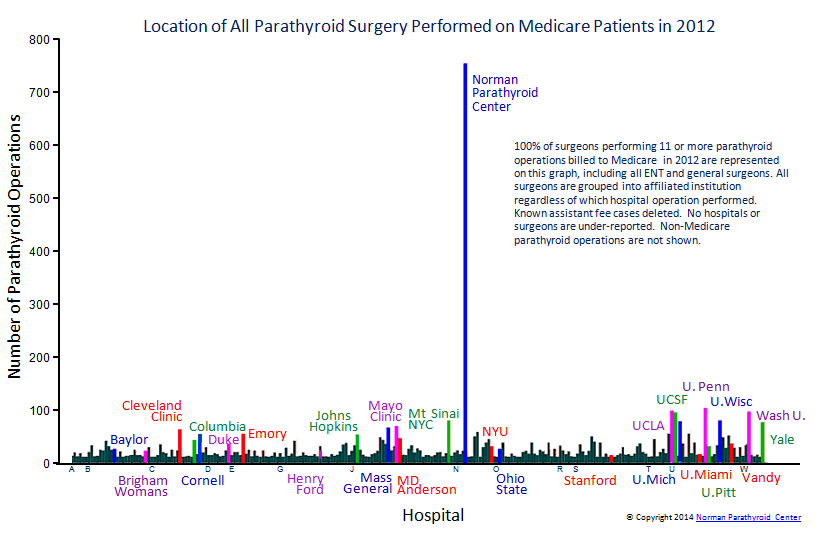
When you look at this graph, remember that each of these lines represents ALL of the surgeons at that hospital or university. It typically includes 3-5 surgeons, both ENT and general surgeons at that hospital that perform parathyroid surgery. So if you go see your local surgeon and he tells you that he does "over 100 parathyroid operations per year" then you can look him up on this graph (or on the public database that the government put out) and tell that he is lying to you. We hear several times per day of a surgeon telling his patients that he does some amazing number of parathyroid operations. Now you can know he is full of poop (as my dad would say).
Several important 1) the Norman Parathyroid Center (the producers of this website) are by far the busiest, highest volume parathyroid surgeons in the U.S (and in the world). 2) Most all other high volume centers are at universities. 3) There are some surgeons with fancy websites online who claim to be high volume surgeons yet the government says they are not (and are therefore, full of poop). 4) Some universities who claim to be experts can't possibly be experts--the data doesn't lie (hello University of Miami and University of Pittsburgh, and about 100 others who's lines aren't even high enough to color on this graph). 5) All of the other "high volume" centers are training centers for new surgeons, so all operations at those centers are done by surgeons learning and not by the experts (this may not be bad, but know it ahead of time) (we do not have surgeons training on our patients--ever). 6) With two exceptions (Cleveland Clinic and Norman Parathyroid Center), the other "high volume centers" will not look at all four parathyroid glands in the vast majority of patients. They will operate until they find the first tumor, measure hormone, and quit. Patients having this operation have at least a 15% chance of not being cured and needing a second operation.
We've said it before, and we'll say it again. We can't operate on everybody with a parathyroid tumor. But as a patient you must understand that your doctor, your endocrinologist, and your surgeon work for you. You are paying them a lot of money to take care of you, so get your money's worth and ask hard questions. If a surgeon tells you that they perform more than 100 PARATHYROID operations in a year, then you will now know that almost everybody that says that is exaggerating their volume--and now you know (they are full of poop). Be smart and ask hard questions. Why isn't your surgeon going to look at all four parathyroid glands? Why wouldn't they want to? And don't put up with the BS answer "because we don't need to". Just watch the video of Dr Norman performing the 13-minute, 4-gland parathyroid operation where ONE parathyroid tumor shows on the scan, yet the patient has two. That is the most important page of our website if you are about to have parathyroid surgery. If your surgeon is honest, they will say that a 4-gland operation will take several hours (2 to 5 hours) and will require a larger incision, and therefore they don't want to do it. OK, that is fine. But if they say that they can measure the hormone in the operating room and figure out if you are cured, know that it isn't quite that easy and they are not giving you the whole truth. Go with the highest volume surgeon you can get and you should be fine!
Read our blog. Some great stories there! Here is the blog about the graph above: Medicare Surgery Volume 2012.
Be smart folks. The doctors work for you!
NOTE: the "10 parathyroid rules of
Norman" first appeared in the New York Times in 1998.
