


Who gets parathyroid problems? Who gets Hyperparathyroidism?
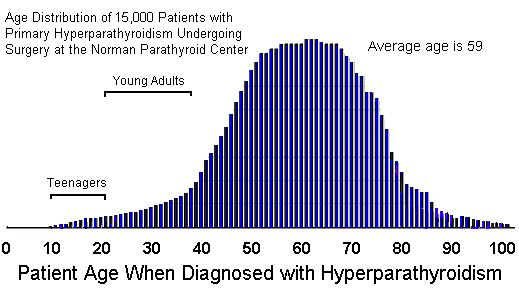
People of every age get parathyroid disease but it becomes much more common as you get older. Hyperparathyroidism is most common in patients in their 50s, 60s, and 70s. Women get hyperparathyroidism three times more common than men. Yet young people develop parathyroid tumors too but far less often than their parents. As more and more young people are getting their blood calcium checked, we are realizing that parathyroid problems are more common in younger adults (30's and 40's) than we ever thought before. Hyperparathyroidism is most common in women over the age of 50--but it is not just a disease of the female senior citizen.The graph below shows the age distribution of patients with parathyroid disease. This data was obtained from 15,000 consecutive patients treated for primary hyperparathyroidism at the Norman Parathyroid Center between 2004 and 2011. This graph represents how common parathyroid disease is for every age. There is a blue bar for every age 0 through 100 years old. The height of the blue bar for each age represents the frequency of parathyroid disease for that age compared to other ages.
Parathyroid Disease Facts that We See from this Graph.
- The average age is 60.
- The most common age is 62. As you can see from the height of the blue bars, more people are diagnosed with parathyroid disease in their early 60's than at any other time.
- Most patients are between 40 and 75. The largest collection of high blue bars is between the ages of 40 and 75. These are very productive years!
- People older than 75 get parathyroid disease. Importantly, these people are excellent candidates to have mini-parathyroid surgery since the high calcium makes many of their other problems worse, and fixing it can make a huge difference in their overall health. Peoplein this group often have heart problems related to the high calcium (like atrial fibrillation).
- We operate on more people over the age of 80 than those under 30. We operate on 1 or 2 people over the age of 80 every day.
- Young adults get parathyroid disease. And, they get it pretty often!
- Teenagers get parathyroid disease. The height of the blue bars is getting pretty low, but teenagers do get it.
- Parathyroid disease is rare below 20 years old. Your doctor has probably never seen it before, but we see it every couple of weeks.
- Parathyroid disease is extremely rare (almost never) below 15 years of age, and when it occurs in this age group is it can occasionally (not usually) be due to a genetic/family disorder such as MEN syndromes (discussed elsewhere).
- ALL patients should have mini-surgery to fix their parathyroid problem. It doesn't matter if you are in your teens or in your 90's, you should have a mini-parathyroid surgery and have all four parathyroid glands examined by an expert in this field.
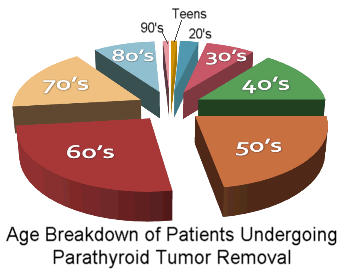
This graph shows the age breakdown in a different format. The pie chart is from 24,000 patients operated on at our center for primary hyperparathyroidism. It is easy to see that most parathyroid patients are between 45 and 75 years of age, but patients in their teens, twenties and those in their 80's and 90's get hyperparathyroidism. Patients of all ages benefit from having their parathyroid tumor removed. Again, the average age is just under 60 years. This pie chart is identical for men and women and was update.
Parathyroid Disease (hyperparathyroidism) in Teenagers and children
There isn't much written about the occurrence of parathyroid disease in teenagers because it doesn't happen very often. But it does happen! Usually teenagers will be diagnosed with hyperparathyroidism after some "event" occurs and they get blood tests. This event is often a kidney stone, a broken bone, or the onset of severe high blood pressure. This leads to the doctors getting blood tests which show a high calcium. The diagnosis of parathyroid disease in teenagers is usually very easy once the doctors do the right tests. Usually it is not subtle, it is very obvious with high calcium and PTH levels. A lot of teenagers with hyperparathyroidism will have calcium levels in the 12 - 13 range, thus there is usually no question about the diagnosis even for doctors who have never had a patient with this disease. Be warned, however, since your doctors have never seen a case of parathyroid disease in a teenager they will do all sorts of tests to look for other problems. After doing lots of x-rays, and blood tests they will be left with the obvious... high calcium levels are due to a parathyroid problem. Geeeezzzz, I wish they would just read this page.
Young patients who don't present after an "event" (kidney stones, broken bone, etc) will often present to the doctor complaining of recurrent headaches, high blood pressure, or failure to grow. Lots of them go from being good students to poor students who can't concentrate at school. Some teenagers have headaches that occur monthly or weekly--and their parents or doctor will think that its due to stress from school or other teenager-type stresses. But if the doctor gets a calcium level it will become clear. Often, the physician will notice that a young teenaged child has stopped growing (they were doing fine but never got a growth spurt). Sometimes the teenager is actually put on growth hormone (their doctor isn't looking for something as simple as a parathyroid tumor). Routine labs will show a high calcium and the diagnosis should be made--as long as the doctor is looking at the labs and realizes that a high calcium level is never normal. Teenagers with parathyroid disease are often (but not always) thinner than their peers. Parathyroid disease in children can also cause a problem with the formation of teeth, and the bones of the jaw may become weak. It is important to remove the parathyroid tumor as soon as it is found in these children so that their growth is not stunted too long. All teenagers with parathyroid disease should have x-rays of their bones to see if the growth plate of the bones has closed... so treatments may be aimed at getting the patient up to their correct height as soon as possible.
Often physicians treating a teenager or child with hyperparathyroidism will run tests on other endocrine glands, specifically the pituitary, the adrenal glands, the thyroid and the pancreas. These tests are performed because the doctors are concerned that the teenager with parathyroid disease may actually have a MEN syndrome (Multiple Endocrine Neoplasia Syndrome) which is a genetic disease that causes tumors to occur in multiple endocrine glands in one person. Parathyroid.com has several pages on MEN Syndrome.
Despite the physicians getting all worked up about the possibility of the teenage patient having a MEN syndrome, they rarely do! That's right... it is so uncommon that you should not worry about it. Let your doctor do the tests on the pituitary and the adrenal (etc) so this is ruled-out, then get the parathyroid tumor removed. (Note we do not do these tests because they are not necessary, and will waste time and money). Again, over 97% of teenagers will have a single bad parathyroid gland as the problem, not 4-gland hyperplasia. The other 3% will have 2 adenomas or 4-gland hyperplasia. Although your doctor (endocrinologist) may say that teenagers are most likely to have a problem with all four parathyroid glands, this is not true. We have the largest experience of teenage hyperparathyroidism in the world (by far) and our data shows that the incidence of more than one parathyroid tumor is actually dramatically lower in patients under 20 years of age. However, we strongly believe that teenagers need to have all four parathyroid glands examined (in fact, we do this with virtually every patient we operate on because it is the only way to assure the patient is cured). Find an expert surgeon who performs mini-surgery that involves the measurement of parathyroid activity during the operation (such as a MIRP procedure) and make sure he/she examines all 4 parathyroid glands (watch the video of this simple 4-gland operation). If your surgeon only removes the one tumor that shows on a scan and then measures some hormone in the operating room, then please bookmark this page because you have a 30% chance of needing a second operation. Twenty percent of the parathyroid operations we do are on people who had a parathyroid operation somewhere else and they were not cured.
OK... back to our topic of hyperparathyroidism in teens: Once the parathyroid tumor has been removed you can expect that the headaches will stop within the first month or so. Bone pain goes away in a few hours. The high blood pressure will usually go away in about 2-6 months. An enlarged (hypertrophied) heart muscle will usually go away in 6 months to two years. Bone density will increase rapidly and bone growth will begin immediately provided the growth plates have not closed yet.
Bottom line... teenagers do get hyperparathyroidism... we operate on a teenager every 2 weeks or so. The biggest problem is to get your doctors to understand this and make the diagnosis... without spending $100,000 on worthless x-rays and tests for other diseases that are NOT present. Again... this is simple... high calcium = bad parathyroid gland = simple operation = get your life back!
You should read the story at the end of this page that shows what a teenager went through with hyperparathyroidism. And then, go to our blog where we have cool stories about lots of different aspects of hyperparathyroidism and read our Teenage Hyperparathyroid Blog. If you haven't seen our blog, then please do---the stories we tell in the blog are very popular. Another very powerful article is written by a mother about "How hyperparathyroidism destroyed my child's life for no reason". This is a sad story, but a great teaching article.
Parathyroid Disease in People in Their Twenties and Thirties
Parathyroid disease in 20-somethings and 30-somethings is not as rare as many doctors would have you believe. Yes, it is much less common (about 1/6 as common) as parathyroid disease in the 50's, 60's and 70's, but that means thousands of people in their twenties and thirties will get parathyroid disease in the U.S. every year. Many of the same things can be said for people in their 20's and 30's who develop a parathyroid tumor as can be said for patients in their teens. They often are diagnosed after a trip to the emergency room with a kidney stone, a bad headache which reveals high blood pressure, a broken bone, or some other symptom of parathyroid disease. Yes EACH of these symptoms are due to the parathyroid tumor causing the release of calcium out of the bones into the blood.
Just like parathyroid disease in the teenage years, when it occurs in the 20's and 30's, physicians often will begin to "jump through hoops" looking for all sorts of bizarre and rare endocrine problems that can be associated with the parathyroid problem. However, just like in teenagers, the chance of one of these other associated endocrine problems occurring is quite rare. Let the doctor do his/her tests, and then rest assured that you have simple parathyroid disease and then get it fixed with mini-surgery. DO NOT BELIEVE YOUR DOCTOR IF HE/SHE SAYS THAT YOU MUST HAVE ALL FOUR PARATHYROID GLANDS REMOVED just because you are young. We hear this garbage all the time from endocrinologists who have never seen a parathyroid gland in their life. All patients can and should be fixed with mini-surgery in an out-patient setting. (read more about min-surgery). If your doctor is making this difficult or dangerous, then get a different doctor. Hyperparathyroidism is a simple disease and its easy to cure.
One interesting thing about hyperparathyroidism in young patients is that women in this age group can become pregnant while they have parathyroid disease. This presents very special problems for both the patient and the mother--which can be life-threatening. We have an entire page on Hyperparathyroidism During Pregnancy so it is not discussed any further here.
Parathyroid Disease in People in Their Forties and Fifties.
As you can see from the graph above, parathyroid problems become more common once people get into their 40's and 50's. The most frequent way that hyperparathyroidism is found in this age group is when a routine blood test shows a high calcium. Once people get into their 40's and above, they tend to see a doctor almost yearly. This is a little more true for women who are seeing their family doctor or a gynecologist for their yearly PAP exams and mammograms. Men also tend to get regularly scheduled physicals. Usually, the yearly physical exam that is performed by these doctors will include blood test such as cholesterol, red and white blood cell count, liver function tests and electrolytes. Sometimes the lab will include a calcium level with these tests (depends on if the doctor orders it this way). If your doctor is 'on the ball', he/she will notice the high calcium and have that test repeated again... if it is high again, they will order a parathyroid hormone test (PTH). If the calcium is high and the PTH is high, then you have hyperparathyroidism (click here to read more about the criteria for diagnosing hyperparathyroidism).
The second most common way that parathyroid disease is diagnosed in patients over the age of 40 is when the patient goes to their doctor complaining of: tiredness, irritability, depression, lack of energy, poor sleeping, loss of sexual desire or one of the other symptoms of parathyroid disease. The doctor will order blood tests and the calcium will be elevated. Sadly, many doctors won't recognize the high calcium as a cause of these problems, and the patients will be put on an anti-depressant (Effexor, Prozac, Wellbutrin, Zoloft, Celexa, Lexapro, Paxil, Serzone). About 60% of parathyroid patients between the age of 30 and 50 will have been put on an anti-depressant (or talked about starting) some time in the previous 2 years (so don't feel alone). The good news that within 1-3 months after getting the parathyroid fixed, almost all patients can be taken off of the antidepressant. The high calcium caused this problem!
Other common ways that parathyroid disease is found in this age group is by the early onset of osteoporosis or when a kidney stone or broken bone occurs. Blood pressure problems are also a key event that causes the doctor to get blood tests--this is also caused by the high calcium. When the parathyroid tumor is removed, the vast majority of people with high blood pressure will be able to stop one or more of their blood pressure medications, and some can be taken off blood pressure medications completely.
Parathyroid Disease in People Over the Age of Sixty.
Parathyroid disease in patients over 60 is very similar to what is seen in patients between 40 and 60. However, in this age group the emphasis is often on the health of the bones (severe osteoporosis) or the health of the mind. Osteoporosis will occur in ALL patients with parathyroid disease given enough time (a few years). As more and more people (especially women) are getting DEXA bone scans to look at the density of their bones, doctors are discovering osteoporosis that is worse than they expected. If they check a calcium level, they can make the diagnosis of parathyroid disease which is causing the osteoporosis. Importantly, there are NO DRUGS that will help osteoporosis caused by a parathyroid tumor... Not Actonel, and not Fosamax. This is not debatable. Luckily, the osteoporosis caused by parathyroid disease is reversible--and it will start getting better the day after the parathyroid tumor has been removed. All the patient has to do is take about 1 gram of calcium per day and a multi-vitamin.
Depression and constant tiredness are very common symptoms for people of all age groups, but especially in those over 40, and even more often in people over 60. Their loved ones will typically say... "she was doing great until a couple of years ago and then she has just gone down hill since then". These symptoms will hopefully get your doctor to order some blood work and not just prescribe some anti-depressants. Fixing the parathyroid will often (almost always) bring back the excitement and enjoyment of life for these patients. Importantly, after the parathyroid tumor has been removed, almost ALL patients who are on ant-depressants won't need these medications any longer.
Of course, patients over the age of 60 will also be discovered to have parathyroid disease after an attack of kidney stones, or when "nothing" is really wrong until a routine blood test shows a high calcium.
REMEMBER... It doesn't matter how old you are, virtually everybody can have a mini-operation that takes 20 minutes or so... performed as an out-patient where you go home about an hour later. Make sure you find an expert surgeon who does a lot of these operations and you can have your problem cured in one morning! If they say it may take 3-4 hours and you have to spend the night in the hospital (or 2, or 3!!), then you know they don't perform many parathyroid operations... go somewhere else. If your surgeon isn't performing parathyroid surgery at least once per week, then don't let them be your surgeon.
Parathyroid Disease in People Over the Age of Eighty.
We operate on patients over the age of 80 every day (actually, we average almost 2 per day over the age of 80, and about one every two weeks over the age of 90). We have recently published a scientific paper showing how well these patients do, and how much better they feel after they had their parathyroid tumor removed. When we look at these patients closely, it is apparent that they had parathyroid disease while they were in their 70's, but one of their doctors said to them "let's just watch it, your calcium is not that high". That is miserable advice. As you know by now, the disease is caused by a tumor. The tumor will not go away. It will not get smaller. It will only get worse. It will not stay the same. And as the patient gets older, the tumor gets bigger and the symptoms worsen... and the bones get worse!!!. So, after these patients have had high calcium for a handful of years, they finally go to a new doctor (like a cardiologist) who finally stops the nonsense and realizes that it is the high calcium that is causing the heart problems and tells the patient that they must get the tumor removed. Do NOT let the fact that you are over 80 years of age be a factor that says you can't have surgery. Sure you can, if you pick your surgeon wisely! Find a surgeon that can do the operation in 30 minutes or less (there aren't many of these surgeons), and get the darn tumor removed! Our data on hundreds of patients over 80 shows that the cure rate is over 99% and the procedure usually take less than 18 minutes. Norman Parathyroid Center surgeons led this study showing how safe it is to operate on patients over 80 and send them home within 2 hours, since the operation was so small and simple. These older patients feel much better when the tumor has been removed. In 1/3, their atrial fibrillation goes away! The citation is: Hyperparathyroidism in patients over 80: clinical characteristics and their ability to undergo outpatient parathyroidectomy. Thyroid. 2007 Apr:17(4):333-339.
A young person's struggle with hyperparathyroidism.
Folks, the following letter is from a 22 year old young lady who had parathyroid disease from the age of 15. This is quite uncommon, but it does occur. Her doctors simply "watched" her high calcium levels while it ruined her life. Please read this and learn... and maybe help your doctors learn. This is a heart-warming story that you will like.
Good evening Dr. Norman,
My name is Brittney S. I am 22 years old and I had parathyroid surgery with you on 7/31/07. I want to give you my deepest thanks for everything you did for me on that day. This year has been a big one for me. I graduated with honors from Arizona State University with my Bachelor's Degree in Social Work, got engaged, secured a new job assisting the elderly, moved back to my hometown, purchased a home and, last month, was married. However, the most remarkable thing that happened to me in 2007 was none of these things. 2007 was not only a year of many changes, it was the year I got my life back.
Since I was 15 years old, I have suffered from headaches. Terrible headaches which led me to be hospitalized, with no diagnosis stemming from this hospitalization. At 17, depression began to uproot my life. The depression was so debilitating that I could no longer function in college and moved home after only one semester at The University of Arizona. While the symptoms of both were manageable, I now realize the effects they had on my life, and the toll they took on my relationships. I pushed to overcome these difficulties, juggling a full time job in management, a challenging internship with victims of domestic violence, and maintaining a 4.0 GPA while getting my degree. However, in August of 2006, I couldn't seem to do it anymore. I completed my internship and entered my last semester of college. Until then, I had assumed that my low energy was a result of the challenging schedule I had created for myself. Though I had noticed my energy decreasing, I was always able to give 100% in all of my roles. I didn't understand why I suddenly couldn't focus, had to take frequent naps and abruptly felt the need to quit my job of several years. I felt lazy, fat and embarrassed. I located a doctor and had many tests done. My doctor told me my calcium was elevated and she would continue to monitor it. She put me back on the antidepressant I had taken during earlier bouts of depression. I thought I was in a rut and would feel better after I graduated and entered a job utilizing my degree.
December is when the bone pain started. It was so bad I couldn't stand up or work more than a few hours at a time. It overshadowed my joy at graduating and becoming engaged. It ruined my plans to immediately pursue my master's degree. I was cranky and mean. I didn't sleep. I cried every day and lashed out at the people I loved most. I grew increasingly anti-social. I saw a new doctor who diagnosed me with hyperparathyroidism. I felt so relieved, I finally had an answer. The solution turned out to be a nightmare. I had an unsuccessful neck exploration with a reputable doctor in February 2007. I am lucky. My surgeon knew he couldn't find the tumor and stopped operating after a couple of hours. He didn't ruin my voice, my scar was only a little terrible. But the disappointment was overwhelming. I had put all of my hope in this surgery and I didn't know what to do next. I saw a surgeon in Scottsdale, Arizona who cruelly told me that he would not operate for at least 6 months after my previous surgery. I felt truly out of options and decided that I had to push forward, even though it was a struggle. I was hired at my new job, bought a house with my fiancé and tried to plan my wedding. I would come home from work exhausted, yell at my mom when trying to confirm wedding details, and cry myself to sleep every night. I almost ended my relationship with my fiancé several times.
Then, when my headaches grew even worse and driving my car became difficult because my wrists hurt so badly that I could barely turn the steering wheel, we found you. I could go on as others have about how quickly you saw me, how smoothly the surgery went. I will tell everyone that I was skeptical and scared of being disappointed again, and that you reassured me. I have never been happier than I was a few hours after you did my surgery as I went out to dinner with my parents and fiancé. You found a tumor, inches below my chest, and, in taking it out, lifted the world from my shoulders. The headaches have stopped. The bone pain was gone almost immediately. You fixed the scar from my first surgery and made it much smaller and less noticeable. I am nicer and I feel like I am a good person again. You changed my life in less than 20 minutes!
There have been uncountable times in the last two months when I have surprised myself at all of the things that I can now do again. At first I found joy in the most simple things, like passing a plate of food across the dinner table without grimacing in pain and losing my grip. Then it was being able to invest time and energy into cleaning my new home and pull weeds from my yard.
Nearly 2 weeks ago, on my wedding day, I was able to walk down the aisle with no pain. I wasn't too tired to stand up and take my vows. I had enough energy to enjoy the entire day. I danced!! I'm not worried that my husband will want to divorce his crazy, cranky wife, which surely would have happened if you hadn't healed me, healing my relationship in the process. I can't even find the words to thank you for making that all possible. I wish I could accurately express how grateful I am to you. I'm sorry for how long this is, but I want everyone to understand that you truly changed my life and made it worth living again. In my job where I strive to make people's lives easier, I only hope to impact one person the way you impacted me. I thank God for you; you and your team were the answer to all of my prayers.
Here is another story about how hyperparathyroidism and high calcium levels affect children:
Patient: J.K. 16 Years Old
Here is some uplifting and positive news for kids with hyperparathyroidism.
Editorial note from Dr Norman: it is very common for teenagers and young adults with hyperparathyroidism to have difficulty in school, often progressing from a good student to a poor student as they get older--because the tumor is growing and affecting they way they lean and their ability to concentrate. Removing the tumor typically changes the student's ability to learn and concentrate, and they become good students again. Usually, this is quite remarkable and amazing to watch.
If you have a child or teenager with hyperparathyroidism, read this mother's account of how hyperparathyroidism destroyed her teenage daughter's life for 5 years because of igorant doctors. "How hyperparathyroidism destroyed my child's life for no reason".
Read read our second Teenage Hyperparathyroid Blog. This is another super-sad story of how children with hyperparathyroidism are ignored by their doctors because they don't know, and for some reason, often don't ask for help! CRAZY!
If you find this page interesting, then you will enjoy a video lecture by Dr Norman on this topic.
If you like art, you will like this work by artist Ali Norman
This page was last updated: 03/08/2024