



There are several pages on Parathyroid.com that describe how parathyroid disease (hyperparathyroidism) occurs. If this is the first parathyroid page you are reading, you should not start here... go back to the Home Page and start from the beginning. This page is an advanced page about the development of parathyroid tumors and will confuse you if you have not read much of the rest of this web site first. You should already know about parathyroid disease and hyperparathyroidism BEFORE you read this page. Make this one of the last pages you read.
We will summarize hyperparathyroidism very briefly in a few bullet points and then spend the rest of our time on this page discussing WHY and HOW the parathyroid gland grew into a tumor in the first place. As a review from other pages on this web site... hyperparathyroidism...
- Occurs when one (occasionally more than one) parathyroid gland grows into a tumor.
- Once the parathyroid gland has become a tumor, it very happily loses control of its hormone regulatory system and starts making parathyroid hormone all the time--way more PTH than your body needs.
- The excess parathyroid hormone circulates in the blood and removes calcium out of the bones and puts the excess calcium into your blood.
- The excess calcium is what makes you sick (causes symptoms). It affects your brain, your nervous system, your bones, your muscles (including your heart), your kidneys, and even your intestinal function.
What Causes Parathyroid Gland Tumors?
Nobody knows why parathyroid tumors form. We do know that virtually 100% of parathyroid tumors are benign and not cancerous. Almost everybody with hyperparathyroidism has one or two parathyroid glands that develop into a benign tumor called an adenoma. In only 4% of people do we know the cause of these tumors. The rest of this page will look at this question more closely. We have divided the page into multiple paragraphs looking at the most common causes of hyperparathyroidism. The most common reason, however, is "we just don't know". Note that the percentages below add up to more than 100% because the causes overlap.
What Causes Hyperparathyroidism? Cause #1:
One of the parathyroid glands grew into a tumor for no known reason. This is 70% of all parathyroid patients -- just one benign tumor for know known reason. No Known Cause.As you already know from our other pages that parathyroid disease is almost always caused by a single bad parathyroid gland. One of the glands develops into a benign tumor called a parathyroid "adenoma". Lets examine this fact closer and examine how this tumor forms (of course we don't know).
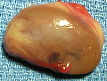 Parathyroid adenoma
We all know that people can get tumors in different parts of their bodies. In fact, we humans develop tumors more often as we get older--its a fact of life that most tumors occur more commonly in our older citizens. Almost every type of tumor that effects us is more common in older patients. Breast tumors and prostate tumors are good examples. Although breast tumors do occur in young females, the vast majority occur in women over the age of 50. It is important to note, however, that parathyroid tumors are essentially never cancerous. We will say that again... parathyroid tumors are nearly always benign. Only about 1 in 2000 are cancerous, so lets not ever talk about parathyroid cancer--you don't have parathyroid cancer. And if you become one of our patients and you bring up the "cancer" word, you will have to do 10 pushups. You do NOT have parathyroid cancer. This is a benign tumor, and a very typical parathyroid tumor (adenoma) is shown here... this is the exact size and this is an average size... some are smaller, and some are bigger. This is a very typical parathyroid adenoma. If we perform your operation, you will be given a picture of your tumor (suitable for framing!) and the amount of hormone it is making will be provided. Your doctors will get a copy of this photo as well.
Parathyroid glands can develop into a tumor just like a breast can develop a tumor; just like you can get a polyp (a form of a tumor) in your colon; just like you can get a tumor in your prostate. (CLICK HERE to look at lots more pictures of parathyroid tumors on a different page). Nobody knows what causes these tumors to form. We don't know why some women get breast tumors while other women do not. Furthermore, we don't know why a woman will get a tumor in one breast and not the other. Similarly, about 90% with parathyroid disease (hyperparathyroidism) will have this disease because ONE of their parathyroid glands developed a tumor while the other 3 parathyroid glands remain perfectly normal. About 8% of people will have two of these parathyroid tumors and two normal glands. We don't know what causes it, but something happens within some of the cells of the parathyroid gland and the cells duplicate themselves over and over again until the gland grows into a tumor. Yep, a "tumor" is simply a mass of cells. A typical parathyroid tumor is about the size of a grape (sometimes as small as an olive, and sometimes as large as a golf ball). Remember, the normal parathyroid gland started out the size of a grain of rice. In summary, we don't know why the normal parathyroid gland grows into this dark red, grape-sized tumor that secretes high amounts of parathyroid hormone (PTH), but we do know that it is not a cancerous tumor and we know that the other glands are normal and if you take out the tumor the patient will be cured. (God gave us 3 spare glands!).
What Causes Hyperparathyroidism Cause #2:
TWO of the parathyroid glands grew into a tumor. This is 26% of all parathyroid patients -- they grow TWO tumors for no known reason. No Known Cause.This is just like the section above, except that there are two parathyroid tumors and two normal glands. One of the parathyroid tumors (adenomas) will be bigger than the other, and usually the bigger (older) one is the one that shows up on a scan. If your surgeon removes only one of the tumors leaving two normal glands and the other tumor behind you will be a bit better, but not cured. You will need a second operation (see our page on re-operations following failed parathyroid surgery). Now you are seeing that parathyroid surgery can be a bit complicated and why experience is the name of the game. This is why we look at all four parathyroid glands when we perform this operation. If your surgeon only removes the ONE parathyroid tumor that they see on a scan, then you will have a 15-20% chance of needing another operation to remove the second tumor some months or years later. The video of Dr Norman performing a 13 minute min parathyroid operation illustrates this point... the scan showed one parathyroid gland but when all of the others were checked, the patient was found to have a second parathyroid tumor. Watch the video. If your surgeon is not going to examine all four parathyroid glands during your parathyroid operation, then you have a 15% chance of not being cured that day, and a 30% chance of needing another parathyroid operation within the next 15 years. Don't let your surgeon cheat--make sure you ask him/her to look at all four parathyroid glands (watch the movie and you will understand this).
Hyperparathyroidism Cause #3:
Radioactive Iodine Therapy in the Past for Thyroid Problems.As you know by now, the thyroid and the parathyroids are un-related. But, they are next-door neighbors in the neck, and they share the same arteries and veins. Thyroid disease is occasionally treated with radioactive iodine. The thyroid is unique in that it is the ONLY tissue in the body that can absorb iodine. So, doctors can give a poisonous form of radioactive iodine to kill the thyroid. This is used occasionally in patients who's thyroid gland is making too much thyroid hormone (hyperthyroidism) (read more about hyperthyroidism on our sister web site EndocrineWeb.com). This will kill the thyroid cells and thus cure the hyperthyroidism. Radioactive iodine is also given to patients if they have thyroid cancer (read more). Once the thyroid is all removed by a surgeon, an endocrinologist will often give radioactive iodine to kill any more cells that may be left behind. This therapy makes thyroid cancer one of the most curable cancers of all! Please don't get confused with the radioactive iodine that is used for x-ray tests like the thyroid scan. This is a different isotope of radioactive iodine and it does not kill any thyroid cells. We are only concerned about Iodine 131 therapy.
Well, some people who have had radioactive iodine therapy for the treatment of a severe thyroid problem can (rarely) develop parathyroid problems. Just like seen in Lithium therapy, the parathyroid disease that occurs after Iodine 131 therapy occurs 20 or more years later (about 25 years is average but can be seen in as little as 15 years). Unlike the parathyroid disease seen following long-term Lithium therapy, however, the parathyroid disease seen many years after Iodine 131 therapy almost always involves just one parathyroid gland. Yep, one of the parathyroid glands develops an adenoma... just like number one above. It is extremely rare for patients who have been exposed to radiation (as in radioactive iodine, or via radiation treatments discussed below) to involve more than one parathyroid gland. We've seen this only a few times in treating hundreds of these patients. Thus, if you have had radioactive iodine ablation (killing) of your thyroid gland in the past, it is important to tell your parathyroid surgeon (again, hopefully your surgeon will understand the relationship and understand its implications).
Hyperparathyroidism Cause #4:
Radiation treatments to the neck and face as a youth or teenager, or as an adult for the treatment of certain cancers.In the 1940's, 1950's and 1960's, doctors believed that radiation treatments were a good way to treat acne in teenagers. They also would use radiation to treat swollen glands in the neck (like an enlarged thymus gland in baby's and tonsils in adolescents). Well, we eventually found out that all this radiation aimed at the neck would affect the thyroid and parathyroid glands. These people are at slightly higher risks for developing thyroid cancer late in life (thyroid, not parathyroid... don't confuse thyroid and parathyroid). These people are also at a much higher risk of developing a parathyroid tumor (always benign, not cancer). So, if you have high calcium and hyperparathyroidism your doctor will ask you if you had radiation to your neck/face as a teenager back in the 50's and 60's.
Another group of patients in this category are those that had radiation for cancer. This includes radiation to the neck or chest for Hodgkins' Disease, Non-Hodgkins' Lymphoma, and even breast cancer. Like the group of young people above getting radiation for benign disease, those getting hyperparathyroidism due to radiation to the neck get the parathyroid tumor about 17 years later on average (range 9 years to 40 years). The incidence of multiple tumors is about 16%, and is usually on the side of the radiation (if the radiation was on one side of the neck).
Hyperparathyroidism Cause #5:
Long term use of Lithium.Lithium is a drug that is occasionally given to patients with certain types of psychiatric problems. It isn't used as often now as it was many years ago. We now have many more sophisticated medications for some of these psychiatric problems. Many patients (as many as 40%) who have taken Lithium on a daily basis for 10 or more years will develop parathyroid problems. Almost all of them will develop a single bad gland (a parathyroid adenoma) just like those patients who develop a parathyroid tumor out of the blue. These patients have a higher rate of developing 2, 3 or even 4 bad parathyroid glands, but most still just have one bad gland. Note, it usually takes 10-15 or more years of taking lithium for the parathyroid glands to develop into a parathyroid tumor, but we have seen it in patients who have been on lithium for only 7 years.
If you have been on Lithium for several years in the past, you must tell your surgeon. Hopefully you would have chosen an expert surgeon who will understand the significance of what you are telling him/her; if they don't know about the relationship between Lithium therapy and the development of hyperparathyroidism, then they obviously are not an expert at parathyroid disease. Go somewhere else! The treatment for hyperparathyroidism in a patient who has a history of long-term Lithium therapy is still surgery where all four parathyroid glands must be assessed to see how many are bad (how many tumors exist). Remember, this does NOT mean you can't have mini-parathyroid surgery. We do mini-parathyroid surgery on 100% of patients... but not all surgeons have the experience to do this. We discuss surgery in more detail in other sections of parathyroid.com.
Hyperparathyroidism Cause #6:
Familial (Hereditary) Forms of Hyperparathyroidism. This is just under 1% of all parathyroid patients.Occasionally, parathyroid disease occurs in families. However, because of the volume of surgery we perform (72 per week), we see patients who have a family member with hyperparathyroidism about once per week. Hyperparathyroidism that occurs in families can occur in women and men, however, it can show up at any age. It would be prudent to have your siblings tell their doctors about your parathyroid disease so they have their calcium and PTH tested... realizing that 97-98% of the time the testing will turn out negative. Beware when asking your relatives about parathyroid disease, however, since most people you ask will say "YES", when they are actually talking about THYROID disease and not parathyroid disease. Thyroid problems are common, parathyroid problems are uncommon.
An often asked question is: Should my children be tested for parathyroid disease now that I have it? Nope, no more than your children should be checked for broken bones after you slip and fall and break your ankle. The exception is this... if two people in the family have hyperparathyroidism, then everybody needs to be checked (again, this is so uncommon I can't believe that I'm writing about it... I should be watching TV). Another exception is that the brothers and sisters of a teenager with hyperparathyroidism should have their calcium and PTH checked.
Bottom line, patients with first-degree relatives with hyperparathyroidism have a slightly higher rate of 4-gland disease, but at least 95% will still have a single or a double adenoma. Do NOT let your surgeon tell you that you can't have mini surgery just because you have family members with hyperparathyroidism. If they say that... go somewhere else! The surgeon's skills determine who can have a mini-parathyroid operation--not the patient's disease.
Hyperparathyroidism Cause #7:
All four of the parathyroid glands grow bigThese are not true tumors, but just bigger, juicy parathyroid glands. This is about 5% of all parathyroid patients. The bigger, fatter parathyroid glands are called "Hyperplastic" parathyroid glands. Also called Parathyroid Hyperplasia.
With parathyroid hyperplasia, all four parathyroid glands grow big and become overactive. These glands are very different from the tumor (parathyroid adenoma) that develops in number 1 above. These hyperactive glands are called parathyroid "hyperplasia", or "hyperplastic" parathyroid glands. These are never cancer. The treatment of this form of parathyroid disease (caused by 4 bad hyperplastic parathyroid glands) is different from the treatment of a single adenoma. The surgeon can't just remove one parathyroid gland... because the excess parathyroid hormone is coming from all four parathyroid glands. Removing just one will not cure the patient. The objective of the surgeon would be to remove just the right amount of the parathyroid glands so that what is left will make the correct amount. This is usually about 3 1/2 (three and one-half) parathyroid glands, leaving about 1/2 of the most normal gland behind. Sometimes the surgeon will remove all four glands and then put part of one of them (about 1/2 of one) into a muscle where it will grow. This was done more commonly in the past, but isn't done that often any more. Usually, 3 1/2 of the glands are removed and the patient is cured. Remember, get a good surgeon, because if all four are removed and none is transplanted back into a muscle, the patient will become permanentlyhypOparathyroid, which can be worse than being hypERparathyroid. It is rare for 4-gland hyperplasia patients to have a calcium level above 11.5. Patients with 4-gland hyperplasia often have MILD or very little elevations in their calcium and PTH levels (almost normal). Beware, however, many patients in category 1 above will also have mild elevations in their labs. Also beware, as stated on the Symptoms Page, the symptoms you get from high calcium are NOT related to how high the calcium is. Very mild elevations in calcium can give people lots of bad symptoms.
In summary, 4-gland hyperplasia accounts for a small percentage of all patients with primary hyperparathyroidism. We don't know what causes it (except in some cases outlined below). All four glands are bad and need to be dealt with. It usually presents with mild changes in the blood calcium and PTH, rarely presenting with very high calcium levels. It can cause very significant symptoms.
Hyperparathyroidism Cause #8:
Multiple Endocrine Neoplasia Syndromes (MEN Syndromes). This is far less than 1% of all parathyroid patients.Multiple Endocrine Neoplasia Syndromes (MEN Syndromes) are covered in detail on a different page of this web site (click here) as well as several pages on our sister website EndocrineWeb.com. This is so rare that it does not deserve too much space on this particular page. The average parathyroid patient does not need to know about this at all. MEN Syndromes are the cause of only 1 in 500 cases of hyperparathyroidism. All of these patients have 4-gland hyperplasia. Thus, the bad piece of DNA that these patients have is inside all 4 of the parathyroid glands, and therefore, all four parathyroid glands get big and juicy, and happily produce lots of PTH. Like every other type of patient of this page, however, these tumors are NOT cancer.
Patients with MEN syndromes will often show up as teenagers. All patients with MEN syndromes should be taken care of by an expert so the surgeon knows what to do.
The following links will take you to our pages on the two main types of MEN Syndrome that are located on our sister website EndocrineWeb.com
More about MEN-1: Parathyroid tumors with pancreas and pituitary tumors (the three "P"s). More about MEN-2: Parathyroid tumors associated with medullary cancer of the thyroid and tumors of the adrenal medulla (pheochromocytoma)
One final note about MEN Syndromes. Often an endocrinologist (or less frequently a family doctor or internist) will see a very routine patient with hyperparathyroidism and then run all sorts of tests on this patient to see if the patient has one of the two MEN Syndromes. This is great medicine in theory, but shows that the doctor has READ more about hyperparathyroidism patients than he/she has actually SEEN. In other words, this doctor is over thinking the problem and doing unnecessary tests! Patients who have hyperparathyroidism do NOT need tests to determine if they have tumors in their pancreas, or adrenal, or thyroid gland. This type of "shotgun" medicine is one of the causes of the high cost of medicine. I deal with parathyroid patients every day of my life, and I see a MEN syndrome patient once or twice a month (and I deal with thousands of parathyroid patients per year). So when your doctor (who sees extremely few parathyroid patients) wants to check you for MEN Syndromes, question him or her on it. Adults do not need to be checked for MEN syndromes. Only children with high calcium.
Hyperparathyroidism Cause #9:
Kidney Disease. This is actually a different disease -- Secondary Hyperparathyroidism.Nowhere else on this site do we talk about secondary hyperparathyroidism. This entire web site is about PRIMARY hyperparathyroidism, with the exception of this paragraph.
Secondary hyperparathyroidism is a VERY DIFFERENT DISEASE. It ONLY occurs in patients who have renal failure, and almost always in patients who have been on kidney dialysis for several years. If you don't have kidney failure, you do NOT have this disease. The term "Secondary" simply is a descriptive term, implying that the parathyroid glands grew big and juicy and are overproducing PTH in response to the kidney disease. Said differently, the parathyroid disease is secondary to the kidney disease.
As you can guess, ALL patients with secondary hyperparathyroidism will have 4-gland hyperplasia. The bad kidney causes its bad influence to be felt by all the parathyroid glands and not just one. Thus, these people do NOT have a single adenoma, they all have 4 bad glands.
Yep, there is such a thing as Tertiary Hyperparathyroidism. Tertiary hyperparathyroidism occurs in patients who have mild secondary hyperparathyroidism and then get a functioning kidney transplant. Usually the normal functioning kidney transplant will cause the parathyroid glands to return to normal also... but not always. If these patients continue to have overactive parathyroid glands, they must have an operation or risk killing their new good kidney with the high calcium in the blood.
You can see from this list, many people have more than 1 bad parathyroid gland. There is absolutely no way for any surgeon to know before the operation which patient has only 1 parathyroid tumor and which patients have more than one. Therefore, if you want to be cured and want to feel better, your surgeon needs to examine all four parathyroid glands during your operation. Taking out a huge tumor and leaving a small second tumor will provide you with zero benefits.
If your surgeon isn't going to look at all four parathyroid glands then he/she is cheating. This is not expertise so don't fall for this gimmic. If your surgeon is not performing parathyroid surgery at least every week, you may want to find a more experienced one. For an expert this should be a very safe operation.
This page was last updated: 07/25/2022