


Parathyroid disease (hyperparathyroidism) during pregnancy is quite rare. However, this can be a very serious problem for both mother and child. It must be addressed in the correct fashion for the best results. The obstetrician and the surgeon must communicate so that both the mother and the child do well.
Potential Risks of Hyperparathyroidism During Pregnancy:
- Increased risk of hypertension (pre-eclampsia and eclampsia) in the mother (about 20 times more common).
- Risk of miscarriage can be as high as 85 percent.
- Risk of permanent hyp0parathyroidism in baby (failure of the parathyroid glands to form).
- Risk of heart rhythm problems during labor / delivery.
- Risk of premature birth.
- Risk of seizures in the baby during first few days of life (due to LOW levels of calcium).
- One of the true emergencies with hyperparathyroidism. Do not fool around here!
Parathyroid disease (hyperparathyroidism) usually affects people in their 50's and 60s and 70s... but some young people do get hyperparathyroidism (see our graph of patient's ages on another page). Treating parathyroid disease almost always involves elective surgery that can be scheduled weeks or even months ahead of time. One of the few times when hyperparathyroidism is dangerous and requires expert care and thoughtful preparation is during pregnancy. The pregnant female is at risk for significant pregnancy problems and complications, but more importantly, the life of the baby is at risk. Furthermore, even a 'normal' pregnancy and delivery do not eliminate the the baby's risk for development problems within their endocrine system -- because of the mother's high calcium levels. Lets look at some of these problems individually.
The Risk of Miscarriage
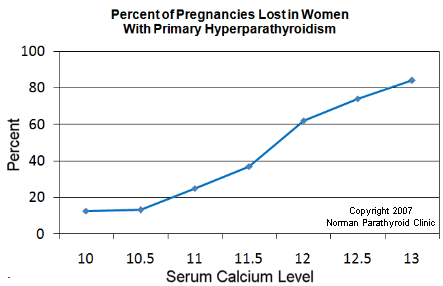
The data about miscarriage (loss of the fetus) in women with hyperparathyroidism (parathyroid disease) comes from the medical literature and from our leading experience in this field. The bottom line, there is a dramatic risk for miscarriage in a mother with hyperparathyroidism. Well over half of all babies will be lost if the mother's parathyroid tumor is not removed. Importantly, the risk is directly related to the calcium level in the mother. Mothers with a very high calcium level (above 12.0 mg/dl) have the highest risk of fetal demise and death. Our recent study (by far the largest in the world) shows that the risk of fetal death is over 50% in women with calcium levels above 11.5, and as high as 85% when the calcium levels get near 13. This graph shows how the risk of pregnancy loss (miscarriage) increases as the mom's blood calcium increases.
In our most recent study, two thirds of women who were diagnosed with hyperparathyroidism during pregnancy had one or more miscarriages in the past several years. Some women had lost 4 babies during the first or second trimester of pregnancy and no doctor realized that the problem was the mother's calcium level. 100% of these ladies had successful pregnancies (no miscarriages) after the parathyroid tumor was removed.
The reasons for fetal death in mothers with hyperparathyroidism is not completely clear, but it is believed that the primary problem is with maternal blood pressure and its effect on the placenta's blood flow.
There should be no doubt that having hyperparathyroidism during pregnancy poses a dramatic threat to the life of the baby (and mother). Ideally, the parathyroid tumor should be removed during the early part of the second trimester by a very experienced surgeon in a very rapid fashion. The average time of this operation in our last 15 pregnant females was 18.6 minutes and was done between weeks 13 and 17. When done in this fashion (as discussed below), it should be very safe for mom and baby, and clearly a MUCH better option than doing nothing and hoping that the baby survives.
Click here to read the journal abstract of our recent publication on this topic, the world's largest series of pregnant females with parathyroid disease (hyperparathyroidism) and high calcium.
Clinical Endocrinology: 2009;Volume 71 Issue 1, Pages 104 - 109
Read our Blog...
We publish interesting stories about hyperparathyroidism twice a week. One of them is on high blood calcium during pregnancy.
The Risk of Permanent Hyp0parathyroidism in the Baby
HypOparathyroidism is the OPPOSITE of hypERparathyroidism. Nearly all of this large web site is about hyperparathyroidism. There is only one page of this web site dedicated to hyp0parathyroidism... click hear to read more. When a person has no parathyroid glands and thus no parathyroid hormone (PTH), then they are said to have hyp0parathyroidism. Since PTH is absolutely required to maintain the calcium in our bodies, people with hyp0parathyroidism have difficulty with calcium metabolism. In fact, these people are required to take large amounts of calcium pills every day of their life, and possibly have a shot of PTH under the skin every day just as a diabetic takes insulin (insulin is a hormone just like PTH -- Insulin runs the blood sugar, PTH runs the calcium).
NORMAL parathyroid glands have a built-in regulatory system... they respond to calcium levels in the blood. When the calcium is low, normal parathyroid glands make PTH. When the calcium is high, normal parathyroid glands shut down and become dormant. This is the danger in the baby! If a pregnant woman has high blood calcium due to hyperparathyroidism, then the high calcium will be found in exactly the same way in the baby. So a pregnant female with a calcium of 12.0 will have a fetus with a calcium of 12.0. Since the parathyroid glands are formed some time during the second and early third trimester, they can be affected by the high calcium. If the calcium level is high, the parathyroid glands that are supposed to be forming can be shut down just as they are supposed to be growing into normal glands. Sometimes, they can be so suppressed that they don't form at all and the baby is born without functional parathyroid glands. If this is the case, the baby will need HIGH doses of calcium in the nursery during the first few days of life, and possibly for life. Again, just as the risk of miscarriage goes up with higher levels of calcium, so does the risk of hyp0parathyroidism in the baby. Note... not all baby's that have signs of hyp0parathyroidism (very low calcium levels) during their first few days of life will have permanent hyp0parathyroidism. Most will have it temporarily and will be fine once they are given enough calcium early on... and their parathyroid glands have a chance to wake up and perform normally.
Another problem for baby's born to mothers with hyperparathyroidism is that these babies can be born with weak bones (almost like osteoporosis). This is because they have been exposed to mom's high calcium which suppresses their parathyroid glands (as discussed above), and because they are exposed to mom's high PTH levels which takes calcium out of their forming bones. Thus, babies born to mothers with hyperparathyroidism are at higher risk of fractures during their early months/years until their parathyroid glands become normal and the their bones begin to calcify better. Think of it this way... the baby's are born with bones that are 9 months behind... they haven't had a chance to calcify and become hard. This is another reason why parathyroid tumors should be removed from the mothers during the second trimester so the bones have a chance at getting hard during the 3rd trimester.
Risk of Seizures in the Baby During First Few Days of Life
Throughout this web site we discuss the importance of calcium in the function of the human nervous system. Calcium is what makes our brain and nerves function (and muscles)... thus most of the symptoms of parathyroid disease can be traced back to the need for the nervous system to have calcium levels in a very tightly controlled normal range. Outside this range (8.5 to 10.2) we get symptoms -- with the symptoms of high calcium being the symptoms of hyperparathyroidism, while the symptoms of a low calcium being the symptoms of hyp0parathyroidism. When the calcium levels in the blood get very low (below 8), we can have seizures.
When a baby is born to a mother with hyperparathyroidism, the baby's parathyroid glands can be under-developed (as discussed above). But, even if the baby's parathyroid glands developed normally, they will be shut-down (suppressed) because that is what normal parathyroid glands do in the presence of high calcium. So, when this baby is born, they will have a high calcium (just like their mother), but over the next 24 hours their calcium will drop -- and continue to drop until their parathyroid glands wake up and start producing PTH. If the calcium goes to low during this time and the doctors are not monitoring it, the baby can have seizures. The treatment is straightforward -- give the baby some calcium into his/her veins to increase the blood calcium levels.
When to Operate on a Pregnant Woman with Hyperparathyroidism
The medical literature is fairly consistent in recommending that the mother be operated on during the early part of the second trimester. The reasons are several. First, operating during the first trimester can be too dangerous for the baby -- the risk of complications due to the anesthesia and/or the surgery is less in the second and third trimester. Secondly, the parathyroids will be forming in the baby during the second and third trimesters, so to avoid the potential of the baby NOT developing his/her parathyroid gland the high calcium levels in the mother need to be removed. Thirdly, high calcium levels during the third trimester are associated with the development of high blood pressure and other complications in the mother (pre-eclampsia and eclampsia).
Thus, hyperparathyroidism in a pregnant female should almost always be fixed. And, this should be done with a minimally - invasive procedure that is as quick as possible, and of course, has a high likelihood of cure. It should be performed in the early part of the second trimester, and it should be performed by an expert parathyroid surgeon. Typically, an obstetrician specializing in high-risk OB should be involved in the care of the mother and baby during this time and during the rest of the pregnancy.
In 2009 we published the world's largest series of pregnant females with hyperparathyroidism. Click Here to read the abstract: Clinical Endocrinology
Unbelievable Stories of Failed Pregnancies and Beautiful Babies:
 Over the past 8 years I've had 5 miscarriages. One was at 10 weeks, the rest as late as the second trimester. This was devastating to me and my husband. I went to several different doctors and several different OB doctors, and not one person could tell me what was physically wrong with me. I had given up all hope of ever being a mother until November 2010 when I went was not feeling well that I went to my yes; line-height: 115%; mso-ascii-theme-font: minor-latin; mso-fareast-font-family: Calibri; mso-fareast-theme-font: minor-latin; mso-hansi-theme-font: minor-latin; mso-bidi-font-family: Times New Roman; mso-bidi-theme-font: minor-bidi; mso-ansi-language: EN-US; mso-fareast-language: EN-US; mso-bidi-language: AR-SA"> family doctor and blood results revealed one week later that my calcium was very high. Not only was I pregnant, but my Dr. said I need to have my parathyroid checked. My calcium levels were always high and every doctor I had ever seen always told me it was no big deal, that some people just have high calcium levels. (editor's note: This is simply not true, it is not normal for people to have high blood calcium!)
After the blood results revealed my parathyroid levels were high as well, I was sent to an endocrinologist, Dr. Lee Metchick. He referred me across the state to Dr. Norman for immediate surgery and at 13 weeks pregnant Dr. Norman removed a large parathyroid tumor. The operation was uneventful; it took 19 minutes and I left the hospital and went home about 4 hours later (they kept me longer than their other patients to monitor the baby's heart rate).
At 36 weeks and 6 days, our healthy baby boy Zyiden was born. yes; line-height: 115%; mso-ascii-theme-font: minor-latin; mso-fareast-font-family: Calibri; mso-fareast-theme-font: minor-latin; mso-hansi-theme-font: minor-latin; mso-bidi-font-family: Times New Roman; mso-bidi-theme-font: minor-bidi; mso-ansi-language: EN-US; mso-fareast-language: EN-US; mso-bidi-language: AR-SA"> All the hope I had ever lost had been restored and today I feel better physically, emotionally and mentally I have ever felt in my life. The parathyroid surgery saved my son's life and made my dream of being a mother come true. If you are pregnant and have a parathyroid problem and want to discuss your situation with me, contact Dr Norman's office and they will put you in touch with me. Tonya W.
Note from Dr Norman. It is clear that Tonya lost some babies because her doctors did not understand that hyperparathyroidism and high calcium puts pregnancies at risk. Trust us, every day we get wonderful, incredible news because we change lives like this. Unfortunately, every day we hear terrible stories of pregnancies lost, moms and dads having strokes, broken bones and broken lives. It is not normal for people to have high blood calcium--and it is dangerous.
Dear Dr. Norman,
On February 12, 2004 you operated on my daughter Marie. At that time she was having all kinds of problems associated with the parathyroid disease, high blood pressure, severe headaches, very high calcium levels, etc. As you know, when you talked to all her non believer doctors they could not believe that a parathyroid condition was the cause of her problems, however, we also discovered that she was pregnant. At that time, a high risk obstetrician insisted that the surgery be done immediately. The operation went very well and you kept my daughter overnight at the hospital because of her pregnancy, we left Tampa on Friday the 13th of February. Of course, every one of her problems went away within 2 weeks of surgery!
On July 11, 2004, Marie gave birth to Olivia Whitney, a perfectly healthy beautiful 7 lbs. 6 oz. 20 inch baby. It is remarkable what you did for my daughter and is proven by the end result.
I take this opportunity on behalf of all my family to thank you for everything you did, without your skills and expertise my daughter could have not carried this pregnancy to term. I am enclosing two pictures, one is my daughter with her children and the new addition to the family, NOTICE ON THAT PICTURE THE MINIATURE SCAR. WOW!
Again many thanks and may God bless you.