



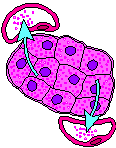
Simply put, endocrinology is the study of endocrine glands. Endocrine glands are a group of glands in the body which secrete hormones. The purpose of the secreted hormones is to cause a specific response in other cells of the body which are located far away. As shown in the picture, the hormones are secreted out of the cells of an endocrine gland into the blood stream giving them access to all other cells of the body.
A great example of how hormones work is shown in our 5 minute video animation showing how a parathyroid gland grows into a tumor that secretes parathyroid hormone which then circulates through the blood stream to cause lots of problems throughout the body. Remember, the definition of a hormone is a molecule that is secreted by one cell which has an effect on another cell some distance away. Watch the video.
Endocrine surgery is the division of surgery which specializes in the surgical treatment of endocrine diseases. Endocrinologists and endocrine surgeons typically work closely together to provide the most advantageous care to patients afflicted with endocrine disorders. Did you know that as of January 2013 there are only 152 active Endocrine Surgeons in the U.S.? To be recognized as an endocrine surgeon you have to devote a major portion of your surgical practice to endocrine disorders and have performed at least 100 endocrine operations. There aren't too many surgeons who specialize in endocrine surgery, and... there are fewer surgeons still who perform more than 10 parathyroid operations per year. In fact the average endocrine surgeon in the US performs only 20 parathyroid operations per year. The average general surgeon performs less than 3 parathyroid operations per year, and ditto for the average ENT (Ear-Nose-Throat) surgeon. It is very important to find an experienced doctor for the endocrine problem you have. Some endocrinologists specialize in diabetes and so if you have a thyroid problem you will want an endocrinologist that specializes in thyroid and doesn't see diabetes patients all day long. Similarly, if you have a parathyroid problem you need to find a surgeon that does parathyroid surgery EVERY WEEK (or a bunch every week!). The same goes for a problem with your adrenal gland--find the surgeon online that does the most adrenal surgery and pick them for your surgeon. We are all endocrine surgeons at the Norman Parathyroid Center, but don't ask us to remove your adrenal gland. Of course we could, but your outcome would be better (lower risk and higher cure rates) if you chose a surgeon that performed adrenal gland surgery every week or two. If you need a parathyroid operation, we're your guys--that is all we do (more than 72 per week!). Be smart when choosing an endocrinologist or an endocrine surgeon.
Examples of Endocrine Glands and Their Hormones
Thyroid Gland. Located in the front of the neck. Secretes thyroid hormone.
Parathyroid Glands.
There are 4 parathyroid glands located behind the thyroid. Secretes parathyroid hormone. parathyroid, parathyroid surgery, parathyroid hormone
Adrenal Glands.
There are 2 adrenal glands located on the top of each kidney. Inner part secretes adrenaline, outer part secretes aldosterone and cortisol.
Neuroendocrine Glands of the Pancreas.
Located deep in the abdomen behind the stomach, the pancreas is primarily a digestive organ. It also contains extremely important endocrine cells which secrete: insulin, glucagon, somatostatin, and others.
Pituitary Gland.
The pituitary is located at the base of the brain. Secretes thyroid stimulating hormone (TSH), follicle stimulating hormone (FSH), adrenocotropic hormone (ACTH), and others.