


Parathyroid surgery (parathyroidectomy) can be quite simple, or it can be extremely difficult. The approach to parathyroid surgery is extremely variable throughout the world, based upon three factors:
-
Experience of the parathyroid surgeon. Multiple scientific studies have shown that surgeons performing an operation many times become better at performing it. The time it takes to perform the operation is less, the complications become more infrequent, and the cure rates increase. The operations become simple, quick, and successful.
-
Technology available to the parathyroid surgeon. Not all surgeons have all the neat new tools and devices available to them. Some can't perform rapid parathyroid hormone assays in the operating room. Many don't have the latest in parathyroid probes and either don't have a probe or have to use a "breast cancer" or "melanoma lymph-node" probe. Very few can measure the amount of hormone being produced by each individual parathyroid gland.
-
Where and when your surgeon trained. Mini parathyroid surgery has only been around for about a decade. Most surgeons have never seen a mini-parathyroid operation and have never had formal training in parathyroid surgery. Unfortunately, many places that perform mini-parathyroid surgery also are in the business of training young surgeons, so even though your surgeon may be experienced, he is actually letting an inexperienced surgeon do the operation while he assists and/or observes. Of course this is necessary, but you may not want this arrangement.
It is important to note that the two main tests used to "find" the parathyroid gland are not on this list. Sestamibi scans and ultrasound scans can be used to help a surgeon find the tumor, but under no circumstances are positive scans required in order for a mini-parathyroid operation to be performed.
The only thing that determines if you can have a mini-parathyroid operation is whether your surgeon can do it. If you are told that "only people with a positive scan" can have a mini-parathyroid operation, then that is true--for that surgeon. The surgeon is telling you the truth: he/she requires a positive scan (some require several positive scans) before they will attempt a mini-parathyroid operation. Although we cannot operate on every parathyroid patient, we perform mini-surgery on 100% of patients. We do not require a positive sestamibi scan. We never use ultrasound scans. We will not stick needles into you prior to your operation. If your surgeon requires this, then that is what they require.
So, why do some surgeons require all this testing prior to a parathyroid operation, while others (like us) require ZERO scans prior to the day of surgery? Why can some do mini-parathyroid surgery on 100% while others will only do mini-parathyroid surgery if the scan is positive?
The answer is EXPERIENCE. Dr Norman performed his 15,000th parathyroid operation in early 2011. There is no other human alive that has done 1000 parathyroid operations. This doesn't mean there aren't some really good parathyroid surgeons in the US, because there are. However when we look back at our practice we can see the evolution of how we perform this operation. We were the developers of mini-parathyroid surgery in the early 1990's. We invented the radioguided approach. We were the first to publish a trial using scopes to perform parathyroid surgery. We were the driving force behind out-patient parathyroid surgery (sending the patient home an hour or so after the operation). We were the one of the first to use local anesthesia (now we know this is stupid). BUT, during our first 1,500 or so patients we required a positive scan before we would attempt a mini-parathyroid operation. Just as nearly all surgeons currently do, we would tell patients that if their sestamibi scan was negative they were not a candidate for a mini-parathyroid operation. In the meantime, we performed thousands more of these operations and by the time we had done a little more than 3,000 we had developed more techniques and tricks that allowed us to perform mini-parathyroid surgery on all patients except those that weighed more than 250 pounds. A few thousand more patients and we learned enough that we now do mini-surgery even in the biggest morbidly obese patients. It simply doesn't matter if you have one bad gland, or 4 bad glands, we do a nearly identical operation, therefore we do NOT require the scan to be positive. Again, we couldn't care less what your scan shows. If you have primary hyperparathyroidism we should be able to cure you with a near 100% cure rate and a near zero complication rate, in about 20 minutes, through a 1 inch incision (less than 220 pounds), and have you go home in about 1.5 hours. We average 12 parathyroid operations daily, if even one of them took 4-5 hours we'd never get to go home.
There are some other minor issues which allow some surgeons to perform more mini-parathyroid operations, such as anesthesia and the nuclear medicine team. Some surgeons who work at teaching hospitals will also have residents (student physicians) perform your anesthesia. This isn't necessarily bad, but it is clearly not as fast and efficient as it could be if the anesthesia was given by somebody that does this every day. We use the same anesthesia team for thousands of cases and they know exactly how to handle parathyroid patients. When you chose a surgeon, you chose his entire team. Do your homework and chose a surgeon who is confident. If you ask your surgeon how many cases he performs, and he doesn't want to answer you, then be careful. If he combines thyroid and parathyroid surgery together into one number, then make him break it down. If he won't look you in the eye when you ask him tough questions, then beware. Of course, this is not just for parathyroid surgery... but for all surgeons.
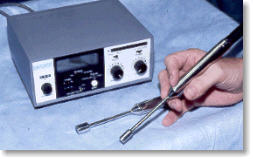 Probe used to find over active parathyroid gland for radioguided parathyroid surgery
Surgeons are funny people. They wear their personalities on their sleeves. You should watch your surgeon and his confidence. Does he say "this is simple and I can fix this easily"? Or, do they want to order a bunch of tests and scans prior to seeing you? Do they want "another" scan? Do they want to stick needles into your neck? Do they say they may need to make the incision bigger? Do they say you may need to spend the night? (we haven't had somebody stay the night in well over 8,000 cases). Do you think you know more about some aspects of this disease than your surgeon? Pick your surgeon wisely. Some are great. Most are not. Be smart!
Probe used to find over active parathyroid gland for radioguided parathyroid surgery
Surgeons are funny people. They wear their personalities on their sleeves. You should watch your surgeon and his confidence. Does he say "this is simple and I can fix this easily"? Or, do they want to order a bunch of tests and scans prior to seeing you? Do they want "another" scan? Do they want to stick needles into your neck? Do they say they may need to make the incision bigger? Do they say you may need to spend the night? (we haven't had somebody stay the night in well over 8,000 cases). Do you think you know more about some aspects of this disease than your surgeon? Pick your surgeon wisely. Some are great. Most are not. Be smart!
The days of giving all parathyroid patients a big operation are gone! Bottom line: Surgeons who perform only a few parathyroid operations per year have a cure rate of approximately 85%. Surgeons who do more than 100 parathyroid operations per year have a cure rate of over 98%. We believe there are less than 4 surgeons in the US who do this many parathyroid operations. Complication rates are more than doubled as well for surgeons who operate on parathyroid infrequently! Pick your surgeon carefully! The airlines know this... they won't let every pilot fly every type of airplane. Nope, each pilot is an expert in one plane type. Outcomes are better this way. Just ask the people on the US Airways flight that landed in the Hudson River. Experience is everything.